
f Healthcare Cybersecurity in Kenya | HIPAA-Aligned Zero Trust for Hospitals | Quest Technologies Ltd
Healthcare Cybersecurity - HIPAA and Zero Trust

Healthcare cybersecurity protects patient privacy, clinical continuity, and legal accountability — using HIPAA-aligned controls and a Zero Trust security model.

Cybersecurity for Healthcare in Kenya

Hospitals, clinics and health networks process highly sensitive patient records (PHI/ePHI), diagnostic data, insurance interactions, and transactional systems. As healthcare becomes digital, cyber incidents can cause service disruption, information leakage, fraud exposure, reputational damage and potential lawsuits.

Healthcare Cybersecurity Kenya HIPAA-Aligned Security Zero Trust Healthcare Patient Data Protection Secure Telemedicine EDR & Endpoint Security MFA & IAM Clinical Systems Security Incident Response

Why Healthcare Cybersecurity Is Different

Healthcare has one of the highest risk profiles because systems must remain available, accurate, and confidential. A cyber incident in healthcare is not just an IT problem — it can disrupt patient care, delay treatment, expose records, and create significant legal and reputational consequences.

Core Risk Areas in Healthcare

  • Patient data exposure: unauthorized access or leakage of PHI/ePHI.
  • Hospital transactional fraud: billing, insurance, claims, and payment systems risk.
  • Telemedicine exposure: insecure sessions, identity misuse, and data leakage.
  • Collaboration leakage: uncontrolled file sharing, messaging, and email compromise.
  • Ransomware disruption: downtime impacting clinical operations and continuity.
  • Third-party risk: vendors and partners handling patient data or system access.

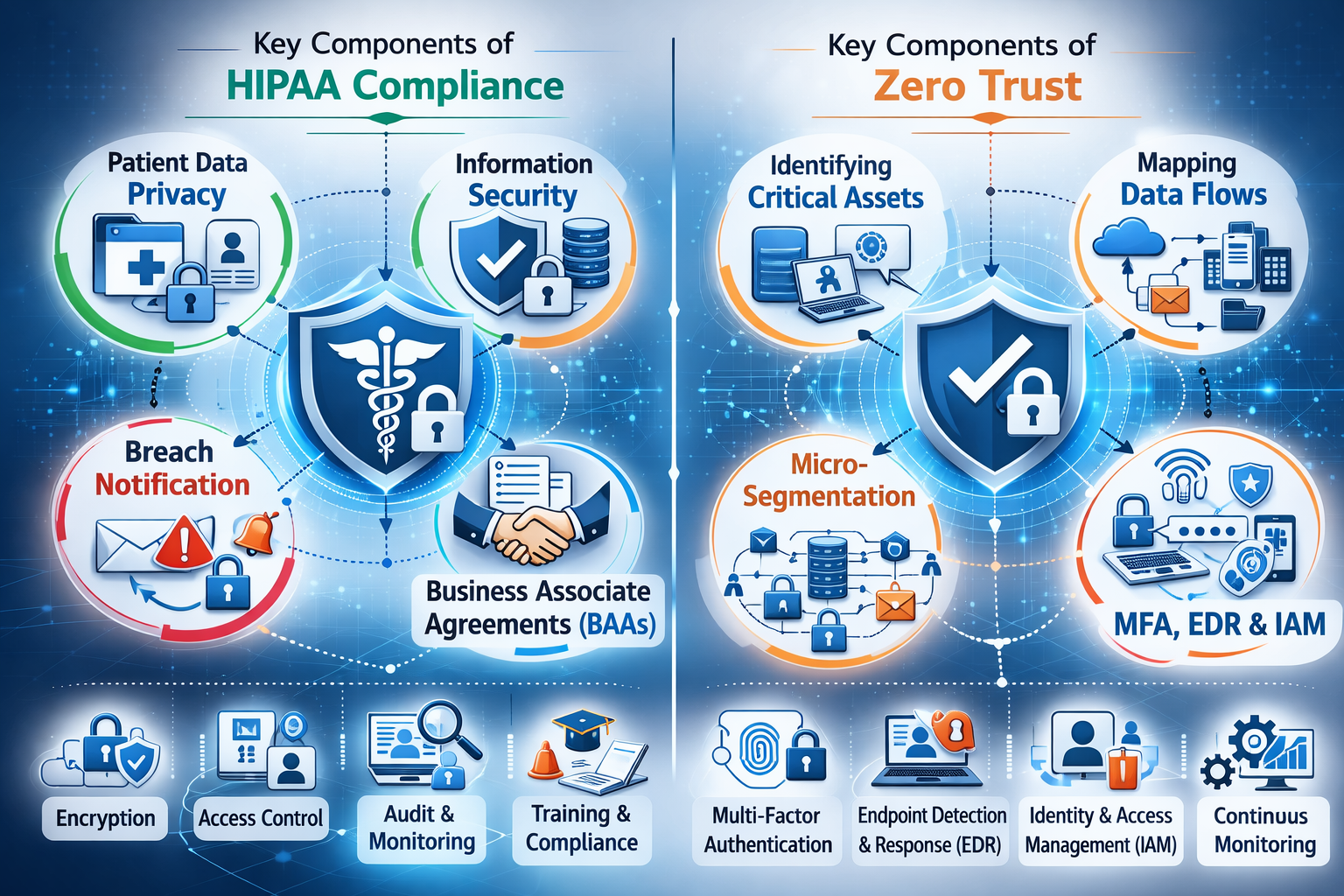
HIPAA-Aligned Protection Focus

  • Patient Data Privacy: access control, audit trails, least privilege and data governance.
  • Information Security: safeguards for ePHI including encryption, authentication and backups.
  • Breach Notification Readiness: detection + response workflows + evidence capture.
  • Vendor & Partner Controls (BAA-aligned): governance for third parties handling PHI.

Zero Trust Security Model for Hospitals

Zero Trust protects healthcare environments where users, departments, devices and partners constantly interact. Instead of assuming trust inside the network, Zero Trust continuously verifies identity, device health, access intent and policy compliance.

Zero Trust Best Practices

  • Identify critical assets: EMR/EHR, PACS imaging, labs, pharmacy, billing and backups.
  • Map data flows: track how patient data moves between systems, departments and third parties.
  • Micro-segmentation: isolate clinical zones, admin zones, guest networks and IoMT devices.

Zero Trust Controls We Implement

  • MFA: stronger access control for staff, remote access and privileged users.
  • EDR: continuous monitoring of endpoints to detect and contain advanced threats.
  • IAM: identity verification, role-based access, access reviews and privileged access control.

How Quest Comes In

Quest secures healthcare environments by combining HIPAA-aligned controls with a Zero Trust approach—protecting patient data (PHI/ePHI), hospital transactional systems, and clinical uptime across on-prem, cloud and remote access.

1) Discover & Scope

  • Identify critical assets: EMR/EHR, PACS, LIS, pharmacy, billing
  • Confirm third parties & integrations (vendors, labs, insurers)
  • Define scope for PHI/ePHI systems and network zones

2) Assess & Validate

  • Vulnerability and exposure review (internal + external)
  • Access boundary review for clinical vs admin vs guest
  • Risk-ranked findings mapped to remediation actions

3) Protect & Implement

  • MFA + IAM (least privilege, role-based access)
  • EDR across endpoints & servers (including shared devices)
  • Segmentation + secure gateways + encrypted backups

4) Monitor & Respond

  • Logging, alerting and incident response playbooks
  • Ransomware readiness and recovery testing
  • Ongoing monitoring roadmap (SOC-aligned)

Offensive (Assess & Validate)

  • Healthcare cybersecurity posture assessment
  • Vulnerability assessment and exposure discovery
  • Penetration testing options (scoped)
  • Data flow and access boundary review for PHI/ePHI

Deliverable: Risk-ranked report + remediation roadmap ready for RFQ scope.

Defense & Remediation (Protect & Strengthen)

  • Network security, segmentation and secure gateways
  • Endpoint security (EDR) across clinical and admin devices
  • MFA and identity governance (IAM)
  • Encryption, backups and ransomware resilience
  • Secure telemedicine, collaboration and communication

Monitoring & Incident Response Readiness

  • Incident response plan and playbooks for clinical operations
  • Logging, alerting and executive reporting readiness
  • SOC-aligned monitoring roadmap (future capability)

Outcomes for Hospitals & Healthcare Institutions

  • Reduced risk of information leakage and potential lawsuits
  • Protected patient privacy and stronger institutional trust
  • Secure clinical uptime and continuity of care
  • Improved compliance posture and governance readiness
  • Safer telemedicine and secure online collaboration

Engage Quest for Healthcare Cybersecurity

Healthcare is a core sector for Quest. We deliver structured assessments, practical remediation roadmaps, and implementation support to secure patient data and hospital operations in Kenya and East Africa.