
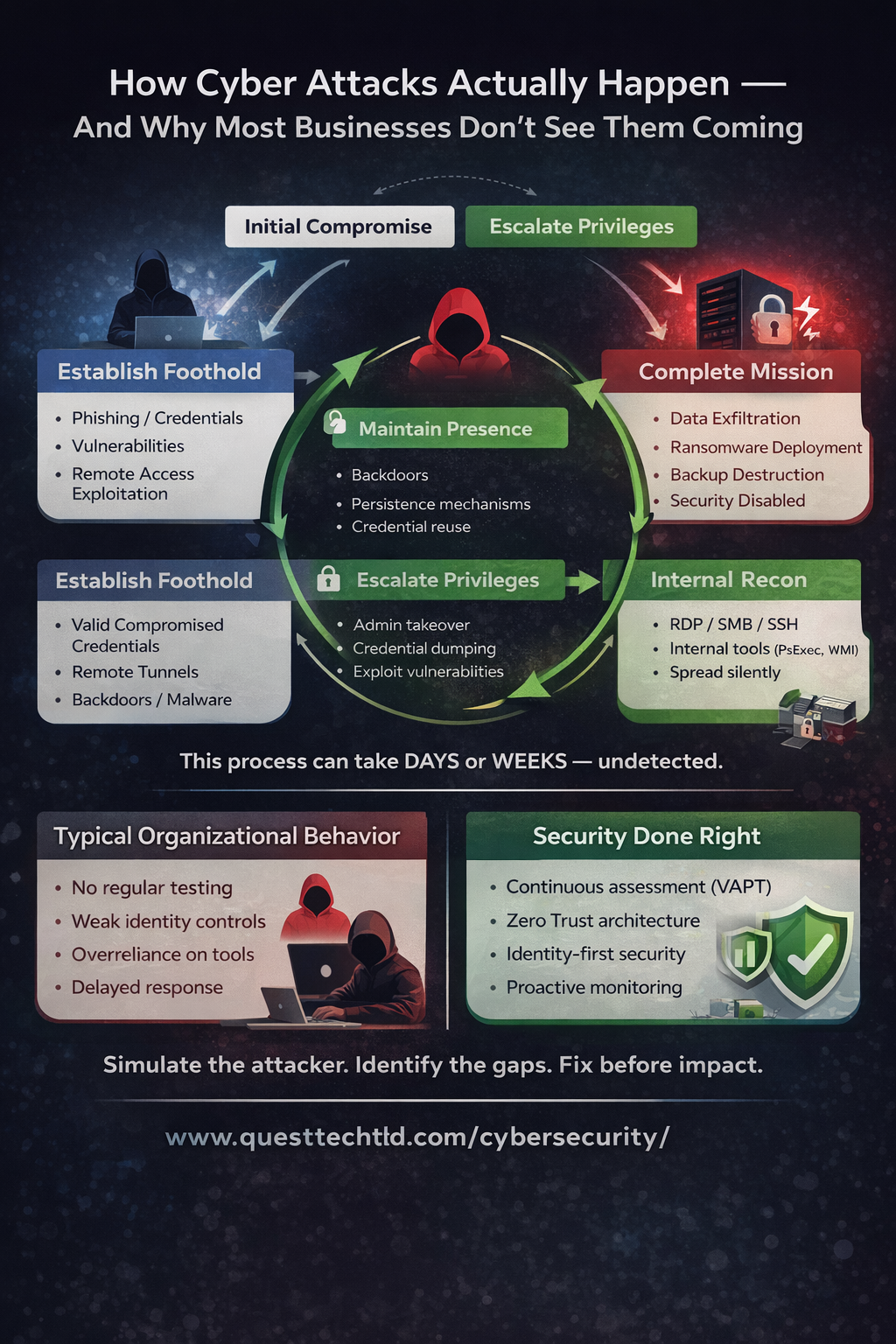
Cyber attacks are usually a process, not a single event
Many organizations only recognize an attack when the final damage becomes visible: ransomware activation, service interruption, data exfiltration, fraud, or compromised systems. In reality, the attacker often enters quietly, validates access, tests defenses, and moves through the environment over time. That is why early visibility matters just as much as perimeter protection.
Why this matters in Kenya and East Africa
Across Kenya and the wider East African region, organizations are expanding digital services, cloud workloads, branch connectivity, mobile access, and third-party integrations. This growth creates opportunity, but it also expands the attack surface. Financial institutions, healthcare providers, government environments, logistics firms, educational institutions, and growing enterprises all face increased exposure when visibility, patching, identity controls, and monitoring do not keep pace with digital transformation.
How attacks actually unfold inside an environment
In many real-world incidents, the attack begins with initial compromise through phishing, leaked credentials, remote access abuse, social engineering, or unpatched vulnerabilities. Once inside, the attacker seeks to establish a foothold, maintain persistence, escalate privileges, and perform internal reconnaissance before executing the final objective.
- Initial compromise: Entry is gained through credentials, malicious email interaction, exposed services, or software weaknesses.
- Foothold and persistence: The attacker establishes continued access so they can return even if the first access path is disrupted.
- Internal reconnaissance: Systems, users, applications, and sensitive data paths are mapped quietly.
- Privilege escalation: The attacker seeks broader rights to access critical systems and administrative functions.
- Lateral movement: Access spreads across endpoints, servers, identities, and network segments.
- Mission impact: The final action may be ransomware, data theft, fraud, disruption, or targeted manipulation of business operations.
Why many businesses do not see the early stages
Organizations often focus heavily on perimeter tools without validating how an attacker could move after the first compromise. Weak visibility, delayed response, weak identity controls, limited logging, and overreliance on tools without testing create gaps that attackers exploit.
- Security controls are deployed, but not continuously validated.
- Logs exist, but are not correlated for timely detection.
- Endpoint and user activity are not monitored with enough depth.
- Remote access, third-party access, and privilege use are not tightly governed.
- There is no structured assessment of likely attack paths.
Why VAPT matters before impact occurs
VAPT helps identify exploitable weaknesses before attackers do. It validates security controls, reveals likely attack paths, uncovers misconfigurations, and gives organizations a more realistic understanding of exposure across endpoints, networks, applications, and access layers. For organizations in Kenya and East Africa, this is especially important where business growth often outpaces formal security validation.
The enterprise response should go beyond assumptions
Reducing risk requires more than awareness. It requires a structured security approach that combines preventive controls, validation, visibility, and response. Depending on the environment, organizations may need a combination of assessment, segmentation, endpoint detection, identity hardening, secure remote access, logging, and managed monitoring.
Quest Technologies Ltd supports this through cybersecurity assessments, enterprise security architecture guidance, and practical implementation aligned to operational realities across modern organizations.
What organizations should do next
Organizations that want to reduce risk should move beyond assumptions and validate their posture. A structured assessment, supported by remediation planning, identity-first security, monitoring, and segmentation, helps close the gap between perceived security and actual resilience. For teams also evaluating stronger detection and response capability, our related insight on EDR, XDR and MDR provides a practical next step.