
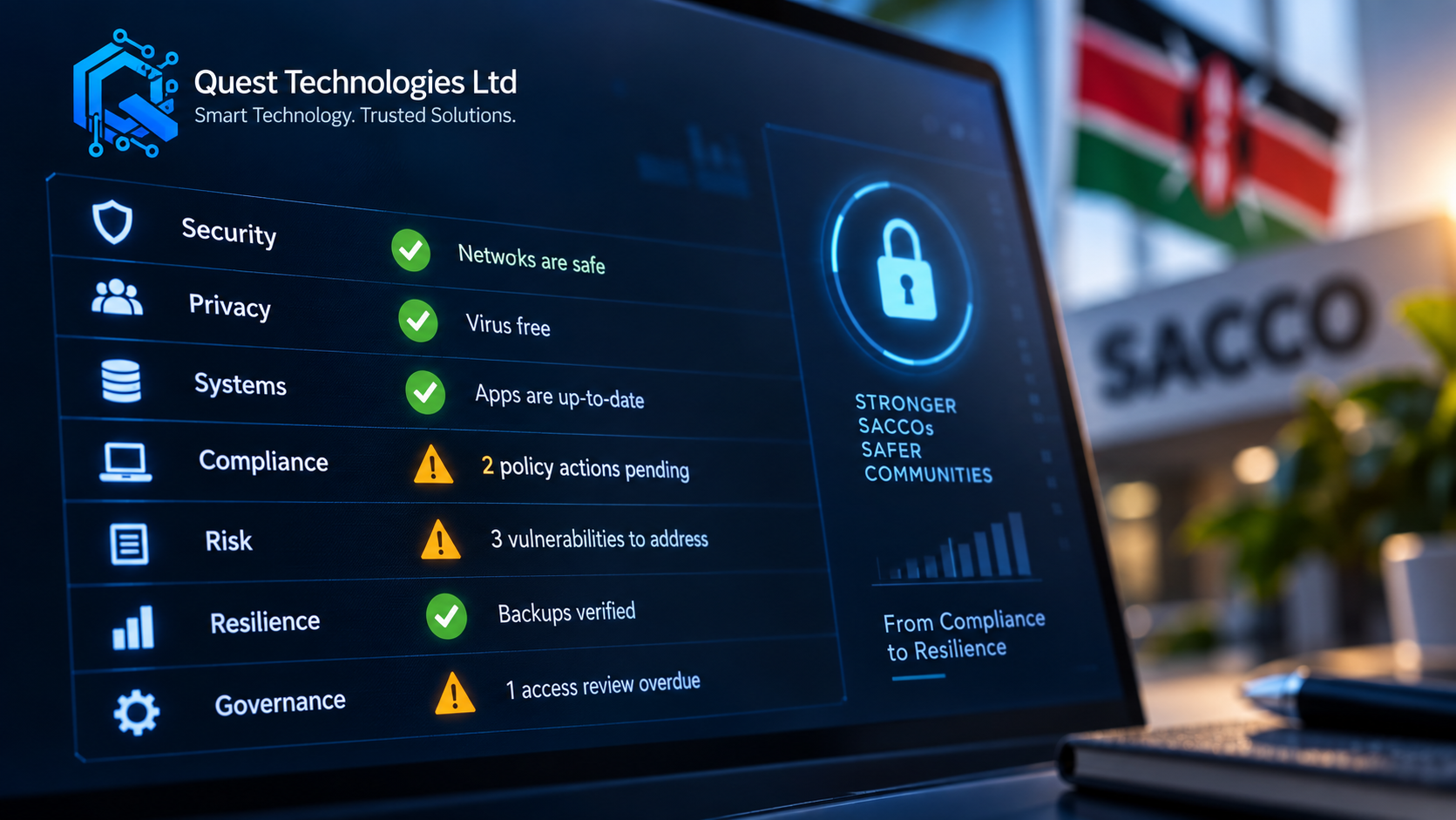
Kenya's SACCO sector continues to digitise. Core banking platforms, mobile services, APIs, cloud infrastructure, payment integrations and third-party fintech services are improving how SACCOs serve their members.
But every new digital dependency can also expand the organisation's cyber-risk exposure. The question facing SACCO leadership is therefore changing.
That distinction lies at the heart of cyber resilience.
Why This Conversation Matters in 2026
On 16 July 2026, the Sacco Societies Regulatory Authority (SASRA) published an update titled “Strengthening Cyber Resilience in the SACCO Industry”. SASRA had also issued a 1 April 2026 advisory on heightened cybersecurity awareness, surveillance and monitoring.
These publications sit alongside existing governance and ICT expectations around cybersecurity, systems audit, business continuity, disaster recovery and accountability for outsourced ICT services.
Important: This article discusses cybersecurity and assurance from Quest Technologies' professional perspective. It does not represent SASRA guidance beyond the official sources linked and should not be treated as legal or regulatory advice.
1. Do We Know Our Actual Cyber-Risk Exposure — or Only What Our Policies Say?
Policies matter. So do cybersecurity frameworks, risk registers, procedures and compliance questionnaires. But documentation alone cannot establish whether an organisation is secure.
A policy may require multi-factor authentication while privileged accounts remain inadequately protected. A firewall may be deployed while unnecessary services remain exposed. Backups may exist without having been successfully restored under realistic conditions.
A documented control tells us what should happen. Evidence helps establish what is happening.
2. When Was Our Technology Environment Last Independently Tested?
Cybersecurity controls should not be assumed to work simply because they have been deployed. They need to be tested.
Depending on the SACCO's technology environment and risk profile, independent assurance may include VAPT, application and API security testing, configuration review, access-control review, infrastructure and cloud security assessment, systems audit and evidence validation.
For a deeper look at attack-path validation, read Penetration Testing: Find the Attack Path Before an Attacker Does.
3. Can Management Prove That Critical Cybersecurity Controls Actually Work?
Consider a simple statement: “Our SACCO uses MFA.” That sounds reassuring, but an assurance exercise should go further.
- Is MFA enforced for administrators and privileged users?
- Does it protect remote access and critical applications?
- Are exceptions documented, justified and reviewed?
- Can the organisation demonstrate where the control is actually enforced?
4. What Happens After Vulnerabilities Are Discovered?
Finding vulnerabilities is only the beginning. Treating VAPT as an annual exercise that ends when the report arrives leaves an important part of the risk lifecycle unfinished.
The real measure of an assessment is not simply how many vulnerabilities were found. It is how effectively the organisation reduces the resulting risk.
See also Your VAPT Report Says “High Risk.” What Happens Next?
Don't let the assessment end with a PDF.
Connect technical findings to remediation ownership, validation and management-level risk visibility.
5. How Exposed Are We Through Third Parties and Fintech Integrations?
A SACCO's digital environment increasingly extends beyond infrastructure it owns directly. Core banking providers, cloud services, mobile applications, payment providers, fintech integrations, APIs and managed-service providers can all become part of the organisation's risk environment.
Outsourcing a service does not automatically outsource accountability.
Third-party risk is not simply a procurement concern. It is part of the SACCO's cyber-risk landscape.
6. Could We Detect, Contain and Recover From a Serious Cyber Incident?
Prevention is essential, but no credible cybersecurity strategy should assume that prevention will always succeed.
- Can suspicious behaviour be detected quickly?
- Can affected accounts or systems be isolated?
- Does management know who makes decisions during an incident?
- Can critical operations continue?
- Can clean data be restored?
- Have recovery procedures actually been exercised?
7. Can the Board See Cyber Risk in Business Terms?
A technical report may say: 3 Critical, 8 High, 17 Medium, 23 Low. Those numbers are useful, but they are not enough for effective board oversight.
- What could happen?
- Which member information, financial process or business service is exposed?
- What evidence supports the finding?
- Who owns remediation and by when?
- Has remediation been independently verified?
- What residual risk remains?
This is where cybersecurity begins moving from a technical exercise toward risk assurance.
From Cybersecurity Assessment to Cyber-Risk Assurance
Traditional cybersecurity assessments remain important. VAPT remains important. Systems audits remain important. Compliance remains important. But individually, none necessarily provides management with a complete picture of cyber resilience.
This is the philosophy behind the Quest Cyber Risk Assurance Framework™ (Q-CRAF™).
Q-CRAF™ is Quest Technologies' proprietary evidence-led approach to structured cyber-risk assessment and assurance. It is designed to help organisations move beyond asking whether controls have been declared toward understanding whether important controls are supported by evidence, technically validated where appropriate, connected to identifiable risks, and followed through remediation and verification.
An Important Distinction
Q-CRAF™ is a proprietary Quest Technologies framework.
It is not a SASRA framework, SASRA certification, regulatory rating or indication of regulatory approval.
Where Q-CRAF™ is applied within the SACCO sector, applicable regulatory requirements and guidance may form part of the assurance context alongside recognised cybersecurity practices, organisational policies and technical evidence.
Cyber Resilience Is Demonstrated, Not Declared
We have a cybersecurity policy. How do we know it is being implemented?
We have firewalls and endpoint protection. How do we know they are effective?
We conduct VAPT. How do we know critical findings were actually resolved?
We have backups. How do we know we can recover?
Those questions move the conversation beyond compliance toward evidence, accountability and resilience.
Is Your SACCO Cybersecurity-Compliant — or Demonstrably Cyber-Resilient?
Quest Technologies helps organisations move from identifying cybersecurity weaknesses toward understanding risk, prioritising remediation and validating whether critical controls are operating as intended.
Cyber-Risk Assessment • VAPT • Evidence Validation • Remediation Roadmaps • Verification • Continuous Assurance
info@questtechltd.com | +254 722 320 428
Editorial & Regulatory Note: This article is provided for cybersecurity awareness and general informational purposes. It does not constitute legal, regulatory or compliance advice.